




Sharpening with Synthetic Waterstones
We have found Japanese waterstones to be the most effective stones for sharpening knives and other blades. Not only are they less messy to use that oil stones, but they do not get clogged with oil, slowing the sharpening process. Lastly, they create a much better edge and are designed to move metal much faster as compared to an equivalent grit of oil stone. Please note that the grits listed are the Japanese grit measurement system. We offer a wide variety of grits of synthetic Japanese waterstones. These can be found for sale in our retail store or on our websites.
Generally speaking, synthetic waterstones can be classified into three groups: coarse stones for the maximum removal of metal, medium coarse stones for refining the edge and establishing the ‘burr’, and finish stones for final honing and polishing of the edge. Coarse stones are available in #80 to #400 grit. Medium stones range from #700 to #2000 grit. Finish stones are available in #3000, #4000, #6000, #7000 and #8000 grits. In addition to different grit sizes, Japanese waterstones vary in a variety of abrasive materials and manufacturing methods.
A typical sharpening sequence is to first establish a flat bevel and remove any nicks with one of the very coarse or medium coarse stones. The choice of grit depends upon how much material needs to be removed from the bevel in order to leave a clean, true edge. If there are no nicks or other defects, the #800 to #1200 grit stones would be a good choice. If more metal needs to be removed the #220 grit stones cut faster and will require less overall effort. The #80 through #400 grit stones are the best choice when a considerable amount of metal must be removed. Keep in mind these stones will leave scratches which must be removed with a medium coarse stone prior to final polishing.
After the geometry is established on the roughest stone used and a ‘burr’ is obtained, the blade is transferred to a finish stone and honed until the "burr" is totally removed. Finishing or polishing can be accomplished in one step, with any stone from #3000 grit to #8000 grit. In general, a better edge will be obtained if the tool is first honed on a #3000 or #4000 grit stone prior to final polishing on a #6000 or #8000 grit stone.
Preparing Stones for Use
Our synthetic waterstones must be soaked in water for several minutes prior to use. You will see the bubbles rise to the surface as the stones absorb water. The very coarse and medium coarse stones can be left permanently in water without damage to the stones. It is always best practice to remove finish stones from the water after use. Under no circumstances should any oil based lubricant be used, as this will ruin the stone.
It is very important that your stones be flat. Checking for flatness is particularly important, since any irregularity in the surface of the stone will be transferred to the cutting tool's edge. After a bit of experience, you will be able to tell by visual inspection whether or not the stones are flat, or you may use a straightedge for this purpose.
How to Flatten Your Stones
The easiest and fastest method to flatten a coarse stone is to rub it across a flattening stone, which is available from our site or in our retail store. Alternately, the stone may be rubbed across wet/dry sandpaper placed on a flat surface. If your stone is fairly flat, #220 grit paper is sufficient. However, if a greater amount of material needs to be removed, then a coarser paper such as #120 grit is appropriate. The finish stones are easily flattened by rubbing them together with a previously flattened coarse stone. It is a good idea to sand a 45° bevel on the 4 top edges of the stone. This prevents ‘pressure-flaking’ of chips from the sides of the stones.
How to Sharpen
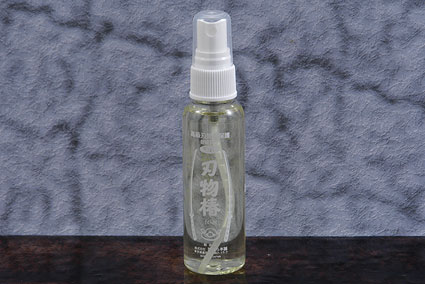
Now that your stones are saturated with water and flat, you are ready to begin sharpening. Place a coarse stone on a flat, secure surface so that it will not shift during use. Begin rubbing the tool back and forth on the stone. Allow the "mud" to build up and remain on the surface. This will give a better sharpening effect and ultimately, a keener edge. Should the stone's surface begin to dry out during sharpening, add a little water to the surface. A spray bottle makes it easy to keep the slurry at the correct consistency. As soon as a wire edge or burr’ is obtained, transfer to a finish stone and polish out scratches left behind from rougher stones as described earlier.
If the tool requires a considerable amount of sharpening, periodically check to ensure that the stone’s surface is flat. If not, flatten as previously described.
Nagura Stones
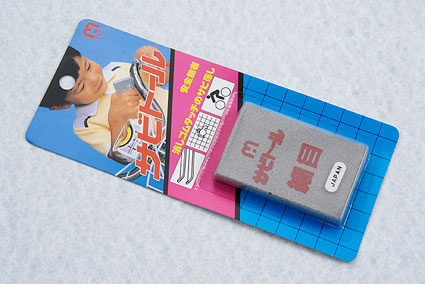
The incredible polishing action of a finish stone results from the ‘mud’ which builds upon the surface of the stone during honing. Nagura stones create this mud before honing begins, thus speeding up the polishing process. In addition, a Nagura stone makes the stone surface slipper, keeping the tool from sticking. Nagura stones are small pieces of very fine natural stone, specially mined for this purpose.
A Nagura stone is easy to use. Simply rub it in a circular motion on the full surface of a finish stone until a paste develops. If the stone’s surface is too dry, the Nagura stone will stick. To alleviate this problem, add a few drops of water. Generally speaking, the more paste, the better the honing action. The slurry should be liquid with significant clouds from the Nagura stone.
Stone Holders
Many of our stones come with stone holders. These are important both because they stop a stone from moving on a table, but also because they raise the stone off the table's surface, making it easier to maintain a constant angle when sharpening. We care both a standard stone holder and a deluxe stone holder.